Government Imposter Scams
Jun 8, 2026 | 2 Minute Read
Government Imposter Scams
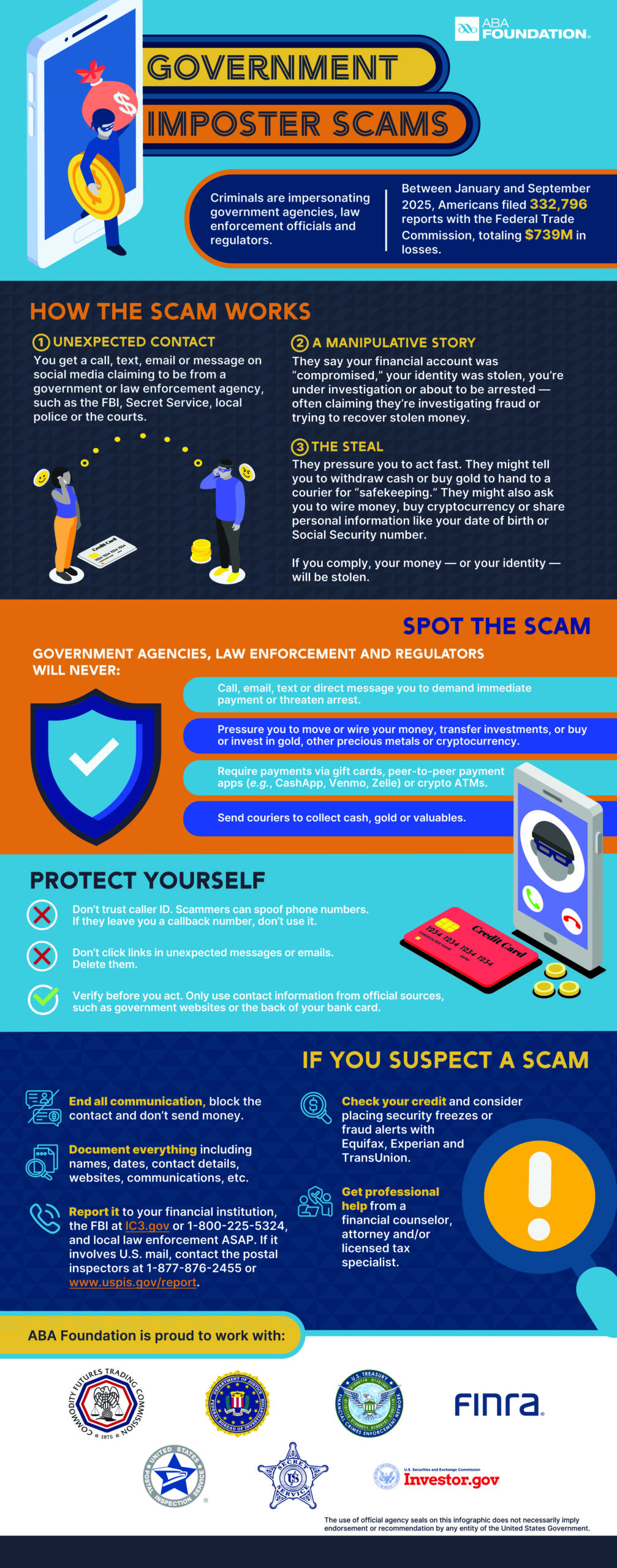
Criminals are impersonating government agencies, law enforcement officials and regulators.
Between January and September 2025, Americans filed 332,796 reports with the Federal Trade Commission, totaling $739M in losses.
HOW THE SCAMS WORK
- Unexpected contact: You get a call, text, email or message on social media claiming to be from a government or law enforcement agency, such as the FBI, Secret Service, local police or the courts.
- A manipulative story: They say your financial account was “compromised,” your identity was stolen, you’re under investigation or about to be arrested — often claiming they’re investigating fraud or trying to recover stolen money.
- The steal: They pressure you to act fast. They might tell you to withdraw cash or buy gold to hand to a courier for “safekeeping.” They might also ask you to wire money, buy cryptocurrency or share personal information like your date of birth or Social Security number. If you comply, your money — or your identity — will be stolen.
SPOT THE SCAM
Government agencies, law enforcement and regulators will never:
- Call, email, text or direct message you to demand immediate payment or threaten arrest.
- Pressure you to move or wire your money, transfer investments, or buy or invest in gold, other precious metals or cryptocurrency.
- Require payments via gift cards, peer-to-peer payment apps (e.g., CashApp, Venmo, Zelle) or crypto ATMs.
- Send couriers to collect cash, gold or valuables.
PROTECT YOURSELF
- Don’t trust caller ID. Scammers can spoof phone numbers. If they leave you a callback number, don’t use it.
- Don’t click links in unexpected messages or emails. Delete them.
- Verify before you act. Only use contact information from official sources, such as government websites or the back of your bank card.
IF YOU SUSPECT A SCAM
- End all communication, block the contact and don’t send money.
- Document everything including names, dates, contact details, websites, communications, etc.
- Report it to your financial institution, the FBI at IC3.gov or 1-800-225-5324, and local law enforcement ASAP. If it involves U.S. mail, contact the postal inspectors at 1-877-876-2455 or www.uspis.gov/report.
- Check your credit and consider placing security freezes or fraud alerts with Equifax, Experian and TransUnion.
- Get professional help from a financial counselor, attorney and/or licensed tax specialist.
Source: https://www.aba.com/news-research/analysis-guides/government-imposter-scams?